A lead generation agency should report eight things every month: meetings booked, meetings held, how many cleared a written qualification bar, pipeline by stage kept apart from revenue, conversion through the funnel, who was reached, what the market said, and what it will change next. Each number needs a written definition you can check.
ORRJO publishes this page, and we run outbound for clients, so read it with that in mind. The buyer advice draws on guides and agency pages from Sopro, Flowd, AdSpyder, AgencyAnalytics, Expandi, Fuzzy AI, SaaS Hero, Prospeo and Lilach Bullock, each quoted, linked and checked 13 October 2026. Every ORRJO fact comes from our platform and methodology pages and our sample insight report.
What must a lead generation report show?
Eight things: meetings booked, meetings held, qualified meetings, pipeline by stage, conversion through the funnel, who was reached, what the market said and what changes next. Every number in it needs a written definition.
- Meetings booked, with the definition attached. A count means little until you know what it counts. Ours, from our methodology page: a "meeting booked" is a confirmed calendar invite accepted by the prospect, with company name, contact name, and meeting time logged.
- Meetings held, and the attendance rate. Prospeo's list of outbound SDR metrics puts it in four words: "Meetings held (not booked)." Attendance is meetings held divided by meetings booked, and the definitions table below gives the industry average.
- Qualified meetings, against a written bar. Fuzzy AI's advice to agencies: "Report qualified meetings, not booked. A meeting that no-shows or fails ICP is a cost, and clients who catch the difference before the agency does stop trusting the rest of the report."
- Pipeline by stage, kept apart from revenue. AdSpyder: "Keep open pipeline separate from completed revenue." Our methodology says the same of our own pipeline figure: the number describes pipeline created, not revenue closed.
- Conversion through the funnel, step by step. Leads, qualified leads and booked calls are different numbers. Lilach Bullock's test of an agency report: "Does it separate leads from qualified leads from booked calls?"
- Who was reached, by name. The account, the person and their job title, so you can check every meeting against your target list. Our sample report explains why: "In a live report this table names the real account, the person and their job title, so the client can see exactly who has been reached and what happened."
- What the market said. Objections, current setups and the words prospects use. The conversations your campaign generates are a deliverable in their own right: the exact words your market uses become raw material for your messaging, your site and your next campaign.
- What changes next. AdSpyder: "End with the next test, expected metric, owner and review date." The last line of our sample report's read-out is "What we are changing on our side, so the client can hold us to it."
AdSpyder boils it down to four questions a report should answer: "What business result occurred? Why did it happen? What changed in lead quality? What will the agency test next?" Flowd's buyer guide makes the same point about meetings: "If reporting focuses only on meetings booked, dig deeper." It lists show rates, opportunity conversion and feedback loops between sales and outreach, and adds: "Pipeline impact matters more than calendar activity."
Which metrics need a written definition?
Every number in the report does, because the same word means different things at different agencies. AgencyAnalytics' guide to lead generation reports puts it plainly: "Your definition of what constitutes a “lead” might vary."
The ORRJO rows below are the definitions behind the figures we publish, as set out on our methodology page. Two rows come from Fuzzy AI's guide, for metrics our methodology page does not cover.
| Metric | Definition | Whose definition |
|---|---|---|
| Meeting booked | "A confirmed calendar invite accepted by the prospect, with company name, contact name, and meeting time logged." | ORRJO methodology |
| Meeting attendance | "(meetings actually held) ÷ (meetings booked) across rolling 90-day windows for ORRJO Lead Generation programmes." Industry average is 70 to 80% (Bridge Group, 2024). | ORRJO methodology |
| Qualified meeting | Clears three checks: right organisation, right person and a genuine need. Anything on top (budget, timeline, a second stakeholder) is agreed at discovery. | ORRJO methodology |
| Pipeline generated | "The value of opportunities that progressed past first qualification stage in the client's CRM, irrespective of whether they ultimately closed." Pipeline created, not revenue closed. | ORRJO methodology |
| Funnel conversion | Read step to step: of the contacts worked, the share that became a live lead; of those, the share that went on to an engaged conversation; of those, the share that converted into a booked meeting. Contacts with dead or wrong numbers are excluded, since they were never workable. | ORRJO sample insight report |
| Positive reply rate | "Positive reply rate is the share of replies that express interest, ask a question, or agree to a next step, excluding unsubscribes, out-of-office and no-thank-yous." | Fuzzy AI |
| Cost per meeting | "Cost per meeting is the client's total monthly spend with the agency divided by qualified meetings delivered." | Fuzzy AI |
Two of these you can check yourself. Attendance needs only your own calendar. Cost per meeting needs only the invoice and the count of qualified meetings. For more on attendance, see our meeting attendance rate explainer.
What are the red flags in an agency report?
The biggest red flag is a report that counts activity and stops before meetings held. Fuzzy AI explains why it happens: "Agencies default to volume metrics because volume is what the agency controls and what the tools count." Watch for these as well:
- No written definition of a qualified meeting. SaaS Hero: "First, insist on a written definition of “qualified lead” with a documented rejection process, because without this every body on the calendar counts as a lead."
- Every stage blended into one number. AdSpyder: "Separate submitted, valid, qualified and sales-accepted leads."
- A meeting count that hides what it cost. Expandi: "You could have set 15 meetings in a month, for example, but if you sent out 5,000+ emails doing so, burned your domain, and went over the budget – that probably was not a successful month."
- Only good news. Expandi again: "Even poor performance (even if it’s outside your control) needs to be shared and discussed regularly."
- Gaps that are not stated. AdSpyder: "Document attribution gaps, sales-cycle lag and missing CRM data."
- No live access to the data. SaaS Hero lists it as a warning sign: "Difficulty getting data or dashboards. Clients who struggle to access performance data or receive monthly PDFs instead of live dashboards face transparency problems that compound over time."
- Data without a read on it. Expandi: "Instead of dumping campaign data in your reports, you should also go the extra mile and explain what it means."
How often should a lead generation agency report?
Live numbers whenever you want them, and a written read-out on a fixed schedule, so the dashboard and the report do different jobs. AdSpyder's suggested rhythm: "Use a live dashboard, short weekly risk updates, a monthly decision report and a quarterly strategy review where appropriate." SaaS Hero's advice: "Ask about reporting cadence and whether you will receive live dashboards or monthly PDFs."
Agencies publish different rhythms. Flowd lists a "Live performance dashboard" and "Weekly campaign reporting", and its homepage says: "Qualified sales meetings booked directly into your team's calendar. Reviewed weekly and optimised." Sopro says: "Alongside regular strategy calls with your dedicated team, the client portal provides live and detailed campaign performance."
At ORRJO, your dashboard lands on the first Friday of activity and is live all month. The insight report is monthly, and market intelligence (what buyers say, what competitors do, which contracts are up) is reported back every fortnight. The numbers get a room on a fixed rhythm: the mandate, the meetings, the accounts, the channels, pipeline by stage, what the market told us, and what changes next.
How does ORRJO report on a lead generation campaign?
Through a live dashboard, a private EU hosted CRM environment and reporting that every ORRJO client gets inside their retainer, with nothing on top. Here is what each part does, in the words of our platform page:
| Part | What it shows | When |
|---|---|---|
| Live dashboard | Meetings booked and held, pipeline by stage, reach by segment, filterable by week, month or quarter. Bespoke to each client, password gated, on its own URL | Lands on the first Friday of activity, live all month |
| CRM environment | Every company, contact, conversation and meeting. EU hosted, run under GDPR, managed entirely by us. If you want the data flowing into your own CRM as well, we wire that up | Logged as it happens |
| Monthly insight report | Who really owns the buying decision. What prospects run today and the objections that keep coming up, counted from the prospect's words only. Conversion through the funnel, step by step, with the read on what we would change next | Monthly |
| Market intelligence | What buyers say. What competitors do. Which contracts are up | Every fortnight |
| Review | The mandate, the meetings, the accounts, the channels, pipeline by stage, what the market told us, and what changes next | On a fixed rhythm |
There is no platform fee and no seat licence for the dashboards, the CRM environment or the reporting: they ship inside every engagement. ORRJO Lead Generation starts from £2,500 a month, and the retainer prices are on our pricing page.
What does ORRJO's live dashboard show?
Meetings booked and held, pipeline by stage and reach by segment, filterable by week, month or quarter, updating in real time for your team and your board. Each client gets a bespoke dashboard, password gated and on its own URL, and it lands on the first Friday of activity, so you see what is happening from week one.
Under the dashboard sits the CRM environment: one clean system of record for your market, with every company, contact, conversation and meeting logged as it happens. There is nothing for your team to install or administer.
To see it before you sign, book a walkthrough: thirty minutes, live, on the demo environment, covering the dashboard, the CRM environment and how a meeting moves through it. No pitch.
What are ORRJO's three data rules?
Only measured data, growth from real snapshots, and nothing silently dropped. The reporting we build follows rules we set for ourselves:
- Only measured data is ever shown.
- Growth is computed from real snapshots, never estimated.
- Nothing is silently dropped: if the evidence stops, the number comes off the dashboard.
We'd rather show you a gap than invent a signal. Our sample report states its exclusions rather than leaving them out quietly. In the funnel, "Contacts with dead or wrong numbers are excluded, since they were never workable." In the section on what prospects say, only the prospect's words are counted: "The rep's side is excluded, because our own pitch mentions the same terms and would otherwise be counted back as market evidence."
How we count the figures we publish, from meetings booked to pipeline and attendance, is set out on our methodology page.
What is in ORRJO's sample insight report?
Six pages of illustrative data for a fictional client, Acme Corp, showing the structure and depth of the insight reporting we produce for clients each month. Every figure and quotation in it is illustrative, so read it for the method, not the numbers. In order, it covers:
- Positive snapshot: where the account stands.
- Purpose: what the market is telling us, not just activity.
- Pipeline: conversion through the funnel.
- Outcomes: meetings booked, status and result.
- Who we are reaching: the buyer map, and how it differs by vertical.
- What people are saying: challenges and current setups.
- Market insights: what this market is telling us.
- Read-out: what this tells us and what we would change.
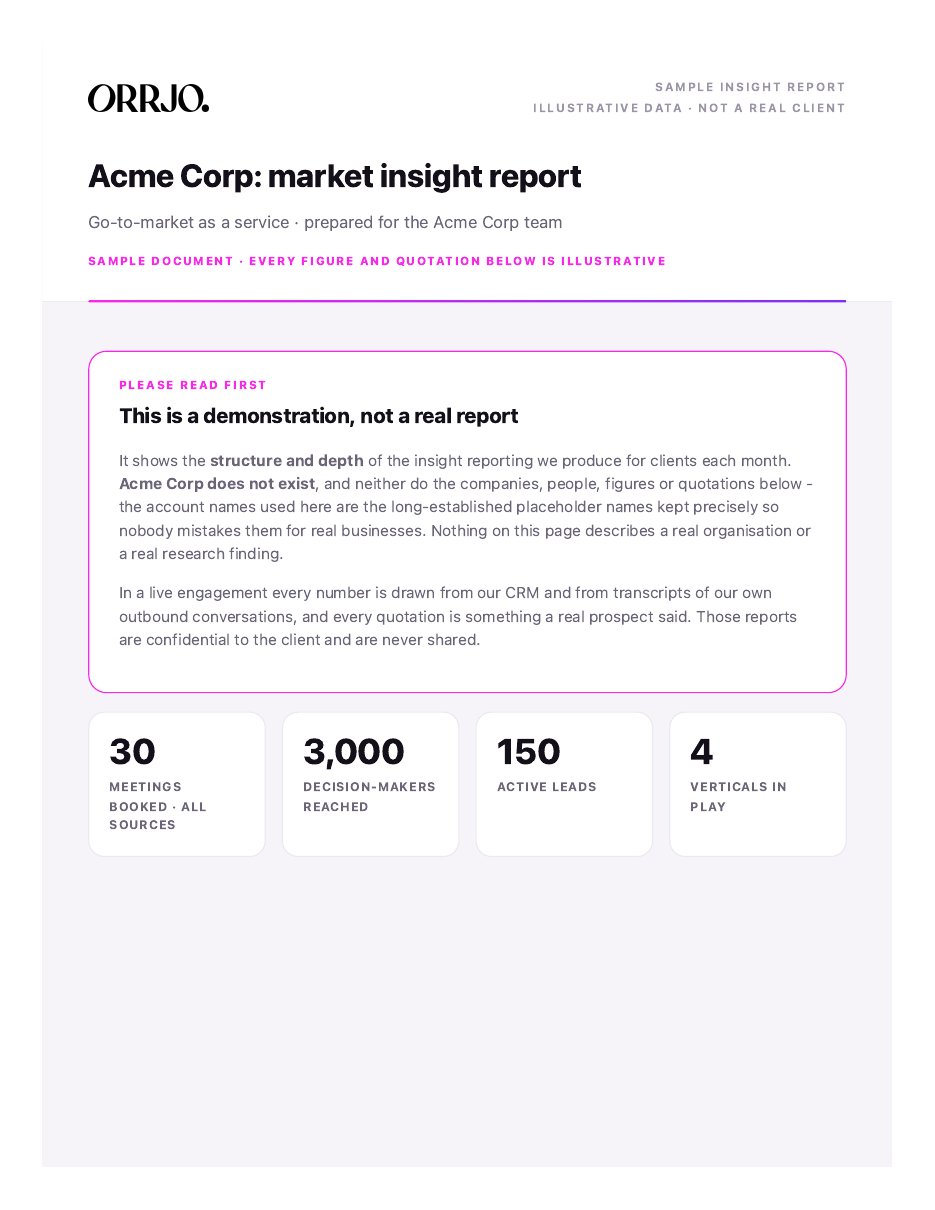
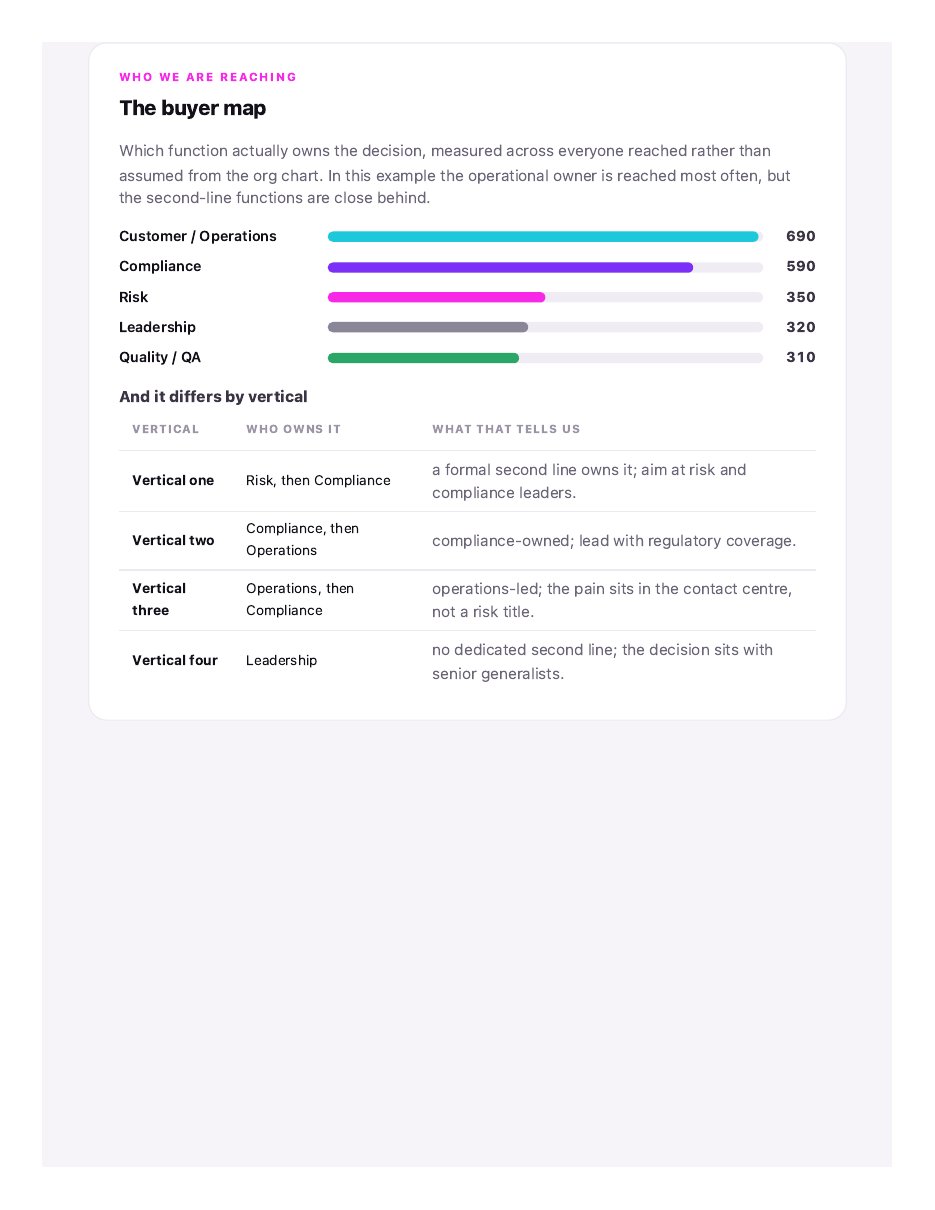
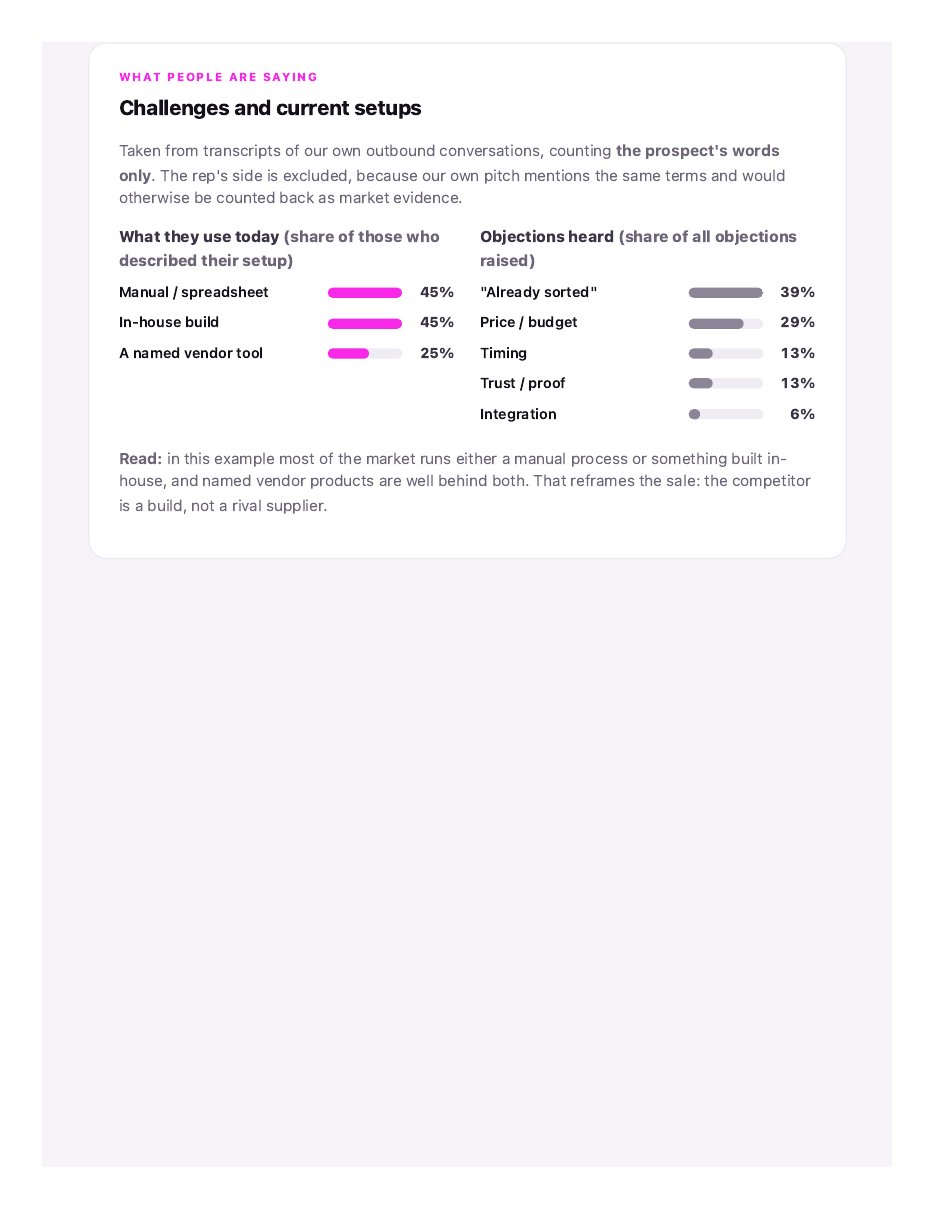
Live reports are different in one way that matters: they name the real accounts, people and findings, and stay confidential to the client. In a live engagement every number is drawn from our CRM and from transcripts of our own outbound conversations, and every quotation is something a real prospect said. Download the sample insight report (PDF, six pages).
How do Sopro, Flowd and ORRJO compare on reporting?
All three give clients live access to campaign numbers. They differ in the reporting around it and in what they publish for buyers. Sopro and Flowd cells quote each firm's own pages, checked 13 October 2026. ORRJO publishes this page.
| Sopro | Flowd | ORRJO (publisher of this page) | |
|---|---|---|---|
| Live access | "Live 24/7 reporting portal", covering "data, prospects, messages, and results" | "Real-time reporting portal" and "Live performance dashboard" | A bespoke dashboard, password gated on its own URL, live from the first Friday of activity |
| Regular reporting | "regular strategy calls with your dedicated team" | "Weekly campaign reporting" | A monthly insight report, market intelligence every fortnight, and the numbers reviewed on a fixed rhythm |
| What the client checks | Set-up, prospect targeting, exclusions, email templates and compliance "can be checked and approved (or otherwise) from inside the platform" | A quick review after each meeting, "so we can track the quality of the meetings we book" | A live report names the real account, the person and their job title for each meeting, and ends with what we are changing on our side |
| Published for buyers | "live, unedited results from every client campaign", updated daily | A buyer guide on what to ask about reporting, including show rates and opportunity conversion | Metric definitions on our methodology page and a six-page sample insight report with illustrative data |
Sopro goes further than ORRJO on one point: its live results page publishes campaign totals across client campaigns, including prospects engaged, leads and cost per lead, updated daily. ORRJO's live reports stay confidential to the client. Flowd's post-meeting review is a check worth asking any agency for. Flowd's pricing table also sets its "Real-time reporting portal" against a "Monthly PDF report" for other agencies and "Manual reporting" for an in-house team.
What should you ask to see before you sign?
A real report from a later month, the written definitions, and the live dashboard itself. Lilach Bullock's advice: "Ask to see month three and month four reports, not month one, because month one is the audition." Then ask:
- Can we have the definition of a qualified meeting in the contract? Lilach Bullock: "Before you sign, get the definition of a lead written into the contract, not just discussed on a call."
- Do we get live access? SaaS Hero's question 18: "Do we get access to a live dashboard or only monthly reports?"
- What do you report on, and how often do we review it? Flowd's buyer guide asks both: "What metrics do you report on?" and "How often do we review performance?"
- How is attendance calculated? Held divided by booked, over what window, and what counts as held.
- Who owns the data, and what do we get back at the end? Our guide to who owns the lead data when you outsource SDRs covers what to ask for.
ORRJO's live reports stay confidential to the client, so we cannot hand you another client's month three. What we can show you is the dashboard, live on the demo environment, and the sample report. Our agency scorecard and our guide on how to choose a lead generation agency list more questions.
Questions buyers ask about lead generation reporting
What should a lead gen agency report every month?
Meetings booked, meetings held and the attendance rate, how many meetings cleared a written qualification bar, pipeline by stage kept apart from revenue, conversion step by step through the funnel, who was reached by name, what prospects said, and what the agency will change next. Every number should come with a written definition, so you can check it against your own calendar and CRM.
What is a good meeting attendance rate?
Industry average is 70 to 80% (Bridge Group, 2024). Attendance is meetings actually held divided by meetings booked. ORRJO publishes 90%+ meeting attendance, calculated that way across rolling 90-day windows for ORRJO Lead Generation programmes, and the basis is set out on our methodology page. Whatever rate an agency quotes, ask how it is calculated and over what period.
Who owns the data in the dashboard?
Get the answer in writing before you sign, from any agency, ORRJO included. Our guide to lead data ownership covers who owns lead data when you outsource SDRs, and whether an agency is the controller or the processor. At ORRJO, the data sits in a private, purpose built CRM environment: isolated, EU hosted, run under GDPR and managed by us. Your data is never compiled across clients, never sold, and never used to train anything. If you want it flowing into your own CRM as well, we wire that up.
How do I know a meeting was qualified?
Check it against a written definition. At ORRJO, a qualified meeting clears three checks: right organisation, right person and a genuine need. Anything on top, such as budget, timeline or a second stakeholder, is agreed at discovery. A live ORRJO insight report names the real account, the person and their job title for each meeting, so you can see exactly who has been reached and what happened.
What does ORRJO's reporting cost?
Nothing on top of the retainer. There is no platform fee and no seat licence for the dashboards, the CRM environment or the reporting: they ship inside every ORRJO engagement. ORRJO Lead Generation starts from £2,500 a month. The final figure depends on the volume of qualified meetings you need and how deep the qualification goes, both set at discovery and confirmed in your proposal.
Can we see the dashboard before we sign?
Yes. You can see the platform before you sign: thirty minutes, live, on the demo environment, covering the dashboard, the CRM environment and how a meeting moves through it. No pitch. You can also download our six-page sample insight report. It uses illustrative data for a fictional client, because live reports name the real accounts, people and findings, and stay confidential to the client.
More on data ownership: who owns the lead data when you outsource SDRs. More on attendance: what meeting attendance rate means.
Sources
- Sopro, Tech and innovation. Client portal coverage and regular strategy calls. No date shown, checked 13 October 2026.
- Sopro, Live prospecting campaign results. Published results from every client campaign, updated daily, checked 13 October 2026.
- Sopro, Pricing. Live 24/7 reporting portal, checked 13 October 2026.
- Sopro, How to outsource lead generation successfully. What clients can check and approve in the portal, checked 13 October 2026.
- Flowd, Pricing. Real-time reporting portal, the comparison table and the post-meeting review. No date shown, checked 13 October 2026.
- Flowd, Outsourced SDR services. Live performance dashboard and weekly campaign reporting. No date shown, checked 13 October 2026.
- Flowd, homepage. Weekly review line. No date shown, checked 13 October 2026.
- Flowd, Questions to Ask a Lead Generation Agency (Before You Sign Anything). Reporting questions and the case for going beyond meetings booked. Published 13 February 2026, checked 13 October 2026.
- AdSpyder, Agency Reporting for Lead Generation: What Clients Actually Need to See. Pipeline and revenue, lead stages, data gaps, the four questions, cadence and next tests. Published 24 July 2026, checked 13 October 2026.
- AgencyAnalytics, What To Include in Lead Generation Reports. Lead definitions vary. Published 19 March 2024, checked 13 October 2026.
- Expandi, The Art of Client Reporting for Lead Generation Agencies. The 15-meeting illustration, sharing poor performance, explaining the data. Published 28 November 2023, checked 13 October 2026.
- Fuzzy AI, Lead Gen Agency Reporting: The 5 Metrics That Keep Clients. Qualified meetings, volume metrics, and the positive reply rate and cost per meeting definitions. Published 29 September 2026, checked 13 October 2026.
- SaaS Hero, Read Lead Generation Agency Reviews Without Getting Fooled. Data access warning sign and reporting cadence. Last updated 2 September 2026, checked 13 October 2026.
- SaaS Hero, 21 Questions to Ask a Lead Generation Agency. Question 18 and the written definition of a qualified lead. Last updated 2 September 2026, checked 13 October 2026.
- Lilach Bullock, What to Ask a Lead Generation Agency Before You Sign. Separating lead stages, later-month reports, the definition in the contract, checked 13 October 2026.
- Prospeo, Outbound SDR Metrics: 2026 Benchmarks & KPIs. Meetings held, not booked. No date shown, checked 13 October 2026.
- Meeting attendance industry average: The Bridge Group, SDR Metrics 2024, as cited on our methodology page.
- ORRJO, platform, methodology and the sample insight report. Every ORRJO fact, definition and price on this page, checked 13 October 2026.